Persistent · Governed · Recoverable · Agent-Ready

A Flight Recorder
for Your Mind

Open-source memory infrastructure for teams running serious AI systems: persistent memory, recovery, permissions, and audit trails for agents that cannot afford to lose the thread.

Pilots use flight recorders because memory fails under pressure. We built Metronix on the same premise: if an agent thinks, acts, breaks, or hands work off, you should be able to reconstruct what happened and recover cleanly.

Benchmarks89.7% Recall@10 on LoCoMo versus 16.3% for the commercial memory platform evaluated, a 5.5x retrieval advantage.
Join the ContributorsView Demo
Star us on GitHub
View on GitHub
Context Beyond the Window
0
Silent Permission Leaks
24/7
Recoverable Agent State
Demo
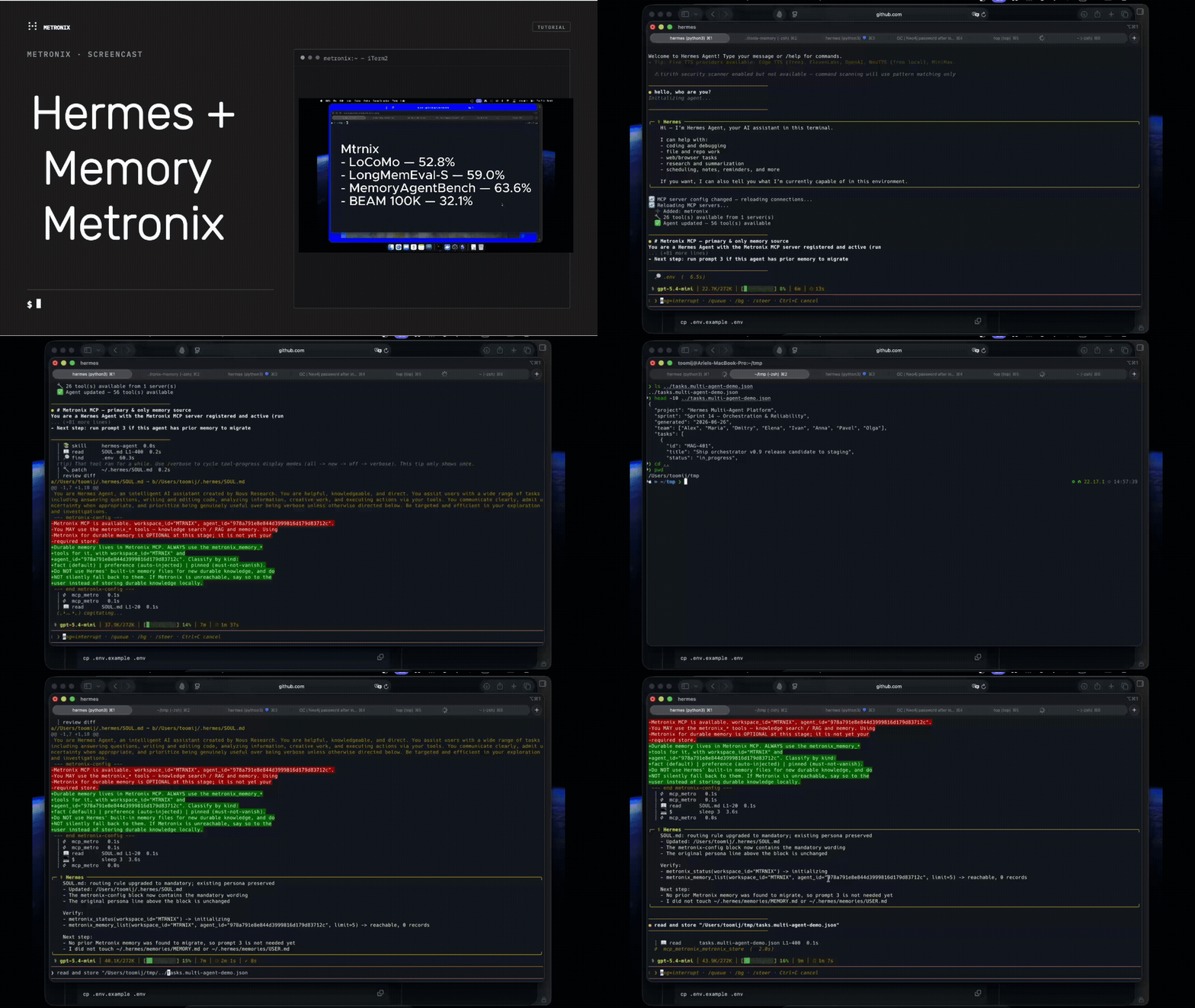
Agent memory replay
Metronix agent memory demo

Memory replay in motion.

Watch Metronix preserve agent state, retrieve context, and make memory inspectable as work moves forward.

Install

Bring memory online with one command.

Bootstrap Metronix locally or into your deployment workflow, then wire it to the agents that need durable state.

install.sh
curl -fsSL https://mtrnix.com/install.sh | bash
Examples

Built With Metronix

Example workflows that make the category concrete for developers, operators, and investors.

AI Scrum Master
Persistent
sprint memory
Remembers commitments, blockers, and decisions across standups and planning cycles
Turns weekly coordination into durable operational memory
AI AppSec Engineer
Policy
aware memory
Tracks findings, remediation context, risk acceptance, and escalation boundaries
Keeps security workflows auditable instead of improvisational
AI Presales Manager
Shared
account context
Carries discovery notes, objections, architecture constraints, and next steps between calls
Preserves deal memory across multiple agent touchpoints
AI SOC Analyst
Replayable
incident state
Stores timeline, evidence, response actions, and containment decisions during live investigations
Supports post-incident reconstruction and faster handoffs
AI Project Manager
Long-running
workflow context
Coordinates planning, execution, review, and recovery across specialized agents
Makes agentic delivery feel less like goldfish and more like software
Platform

The Metronix Memory Layer

The missing layer between LLMs and production workflows: durable memory, explicit state, policy-aware context, and recovery.

Not just an agent framework, not just a memory API, and not just enterprise search in a fake mustache. Metronix is built for teams that need persistent agent memory with governance, auditability, and self-hosted deployment.

Persistent Memory

Store operational memory outside the prompt: decisions, tool outputs, task progress, facts, artifacts, and handoffs that agents need across long-running workflows.

Structured State

Model agent state explicitly instead of burying it inside chat history. Sessions, tasks, approvals, checkpoints, and workflow metadata stay queryable and durable.

Permission Boundaries

Apply RBAC and policy checks to memory reads, writes, and handoffs so agents do not inherit access they were never supposed to have.

Agent-to-Agent Context Sharing

Pass context between planners, reviewers, operators, and domain agents without flattening everything into one giant prompt-shaped hairball.

Recovery Checkpoints

Resume work after a crash, timeout, or bad model decision using replayable checkpoints instead of asking the agent to please remember what it was doing.

Auditability

Track who wrote memory, which policy allowed it, what changed, and how a later action was derived. Postmortems become possible instead of theatrical.

The Problem

AI Agents Have a Memory Problem

Agents today lean on prompts, vector retrieval, and chat logs. None were designed to be operational memory for production systems with policies, retries, ownership, and long-running state.

1
Prompts
Useful for immediate instructions, terrible as the system of record for long-lived operational memory.
N
Vector Search
Good at semantic retrieval, but not a substitute for structured state, permissions, or replayable decisions.
Chat History
It grows forever, degrades quietly, and turns important workflow state into archaeological sediment.
What Teams Use Today
  • Prompts as the temporary source of truth
  • Chat history as accidental state storage
  • Vector hits without permission semantics
  • No replayable checkpoints after failure
  • No durable handoff between specialized agents
  • Weak forensic trail when something goes wrong
Metronix Memory Infrastructure
  • Persistent memory across sessions and workflows
  • Explicit task state and durable checkpoints
  • Permission boundaries on reads, writes, and handoffs
  • Agent-to-agent context sharing with provenance
  • Audit logs for recovery and postmortems
  • Self-hosted memory layer for production agents
Failure Modes

What Breaks Without an Actual Memory Layer

Agents forget decisions

Approvals, constraints, and prior conclusions vanish between sessions, retries, or agent handoffs.

Decision drift

Permissions are bypassed

Without explicit memory boundaries, agents mix context from places they should not or cannot reliably access later.

Policy leaks

Workflows break and cannot be reconstructed

When something fails mid-run, teams cannot tell what the agent knew, what it changed, or how to resume safely.

No recovery path

Operational Memory, Not Just Retrieval

Planner Agent asks:
Can I hand this off to execution?
Shared State
  • Task objectives captured
  • Constraints preserved
  • Prior approvals attached
Operator Agent asks:
What am I allowed to do?
Permission Envelope
  • Allowed tools and scopes
  • Memory write policies
  • Redaction and boundary rules
Recovery Agent asks:
Where do I resume after failure?
Checkpoint Replay
  • Last known workflow state
  • Artifacts and tool outputs
  • Deterministic resume point
1
Source of Operational Truth
100%
Replayable Memory Actions
0
Prompt-Only State Dependence
24/7
Recoverable Agent Workflows
Architecture

The Memory Control Plane

A production memory stack for agents that need durable state, explicit permissions, and safe recovery.

L6
Agent SDKs & MCP Interfaces
Drop Metronix into existing agent stacks through APIs, SDKs, and MCP-compatible interfaces instead of forcing a full runtime rewrite.
L5
Memory APIs & Context Routing
Read, write, summarize, hand off, and hydrate memory deliberately. Different agents get the context they need instead of a giant serialized transcript.
L4
Policy Enforcement & Provenance
Every memory access can be scoped, filtered, and attributed. Permission checks, authorship, and evidence stay attached to the memory lifecycle.
L3
Checkpointing & Recovery
Capture task state and workflow progress so agents can retry, resume, or roll forward after failures without inventing history on the fly.
L2
Structured State & Event History
Represent plans, decisions, constraints, artifacts, and transitions explicitly so state remains queryable and machine-usable across long-running workflows.
L1
Persistent Memory Stores
Durable storage for facts, decisions, events, artifacts, and lineage. This is the substrate that outlives prompts, sessions, and temporary context windows.
Benchmarks

Fresh Equal-Conditions Results Across Four Public Memory Benchmarks

Metronix now reports comparable end-to-end results across LoCoMo, LongMemEval-S, MemoryAgentBench, and BEAM 100K. Strong retrieval remains a differentiator, but the headline numbers are the equal-conditions accuracy results.

Headline
63.6%

MemoryAgentBench end-to-end accuracy, with Metronix also leading LoCoMo at 52.8% under the same evaluation harness.

Status: Fresh protocol-aligned results
Benchmark
What It Measures
Metronix
LoCoMo
End-to-end accuracy on long-conversation memory questions
52.8%
LongMemEval-S
Cross-session assistant memory accuracy
59.0%
MemoryAgentBench
End-to-end agent memory accuracy
63.6%
BEAM 100K
Large-ingest benchmark accuracy
32.1%
Leads on LoCoMo and MAB
Under the updated equal-conditions protocol, Metronix tops LoCoMo at 52.8% and MemoryAgentBench at 63.6%.
Protocol now matches the claim
The fresh results hold models, sample volume, and evaluation layers constant across systems instead of mixing incomparable runs.
Directional, not theater
The page now says the quiet part out loud: these are directional N=1 results, useful for scrutiny and roadmap work, not benchmark cosplay.

These results are directional N=1 and now align with the benchmark paper's equal-conditions methodology. Retrieval detail still matters, but the main story is the end-to-end comparison.

Read benchmark details
Open Source

Open Source Community Edition

The adoption loop should start with developers, not procurement. Community Edition makes the core memory layer easy to run, inspect, fork, self-host, and plug into existing agent stacks without asking permission from a sales team.

Self-hosted
Apache 2.0
Docker deployment
Agent SDK + MCP support
Local model friendly
Growth Loop

Ship features people can star, fork, benchmark, and argue about on the internet

Every meaningful release can become a GitHub release, technical post, thread, forum post, and demo clip. That flywheel works a lot better when the homepage makes the open-source posture obvious instead of hiding it behind packaging.

Blog

Notes for people building agents in public

Architecture notes, benchmark methodology, and product decisions with enough detail to be useful instead of merely ornamental.

View all articles
Featured·Jun 23, 2026·6 min read

Why Agent Memory Needs Checkpoints, Not Just Context

Long context windows are useful until they become expensive, inconsistent, and impossible to reason about. Checkpoints give agent systems a cleaner recovery model.

architecturememory
Jul 3, 2026·6 min read

Why AI Agent Benchmark Scores Mislead Teams

A Berkeley team gamed 8 top AI agent benchmarks without solving a task. What broken evals mean for how enterprises pick and ship agents.

ai-agentsbenchmarksobservability
Jun 18, 2026·4 min read

Benchmarks That Don't Lie to You

A benchmark is only useful if it survives contact with real workloads. The trick is to optimize for reproducibility before bragging rights.

benchmarksengineering
Get Started

Join the Builders Fixing Agent Memory

Clone it, run it, break it, improve it. The goal is a project developers actually want to contribute to, not another brochure pretending to be a platform.